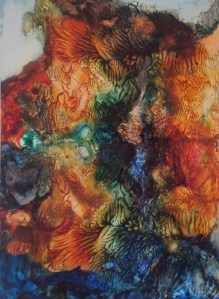
 There is an abundance of symmetry throughout nature. The vertical Rorschach is used in psychiatric evaluation because its combination of symmetry and complexity suggests living creatures. The symmetry and complexity of the horizontal Rorschach evoke the living landscape: mountains and water.
These Rorschach paintings also allude to the tradition associated with them, which is interpretation. They are emphatically open to interpretation. For me they usually evoke water. Sometimes flowing, sacred water, rolling down the mountain from a faraway glacier, pristine in its virginal and wild woods. Sometimes swamps, sometimes tidal waves coiled up high, about to strike. Life eternally being renewed- paradise and the lotus land. For you, perhaps, something else.
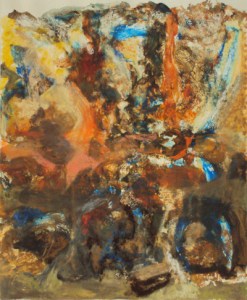 There is a certain ambiguity of space in these paintings that forces the brain to continuously reinterpret the scene. Positive and negative space transpose, what might be rocks and trees suddenly shifts to reflection. Moreover, the spatial ambiguity is not hazily ambiguous but rather shifts dramatically, depending on one’s interpretation, almost like some of M.C. Escher’s paradoxes. There is at the same time the shifting between the illusory space of the landscape and the flatness of the paint of canvas.
Art is always symbolic, and the ultimate referent for the symbol is always true nature, the Absolute, the unity of subject and object. As in metonymy where the part symbolizes the whole, the painting attempts the impossible, to encapsulate the Whole. It must therefore break the simple symmetry of the Rorschach, as if to indicate still further, yet unseen levels of symmetry, a supersymmetry impossible to conceptualize, let alone depict.
 Natalie Watson
